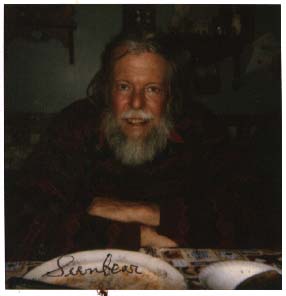
NOTE: This story is based on a composite of my own first-person experiences and observations as well as what I learned from talking to as many people as possible who were involved in any way with the events around Sun Bear's tragic death. Sun Bear was a wonderful human being and my hope is that we can draw whatever lessons we need to from this incident.
Sun Bear's last day was a mundane one, at least at first. He woke up on July 12th at NERF, where he always camped, and had a late-morning breakfast. He was in a cheerful mood in spite of a cold that was slowing him down. NERF was doing cleanup work by day and hosting mellow music jams by night. Many of Sun Bear's friends at the kitchen were the same people who had thrown a surprise 70th birthday party for him in December. This was his 14th gathering, and he was having a good time.
During the gathering, Sun Bear had rarely left his perch on the ridge overlooking Bear Creek except to help count the money that was collected each night in the Magic Hat. He was looking forward to staying until July 17th, before returning to New Hampshire for a medical appointment. He had had minor heart surgery in May and the doctor wanted to see how he was doing.
Sun Bear decided to leave the muggy, stifling heat of the Gathering for an afternoon to venture into town with a couple of friends. He was looking both to relax and to research how best to set up the Rainbow '99 Cleanup Fund. He had heard that there were many people on the outside who wanted to send donations to the Magic Hat.
He went to Ridgway and had a couple of cheeseburgers at Aellos on Main St. He thought all the protein would do him some good. I first ran into him in front of the Elk County Courthouse. I had just tried placing a phone call and he was putting more change in the parking meter where a friend's white Cutlass station wagon was parked. We stopped and made small talk for a couple of minutes. Tall and broad-shouldered, he looked around at all the young hippies sprawled out on the courthouse lawn and joked about how there were now more gatherers in Ridgway than back at camp. He then hurried along to get to the YMCA in time for a $1 hot shower.
Later, I saw him walking in front of the Dollar General store. He was running his fingers through his long, damp silver hair. We had worked together in the same kitchen for the past six years and I was going to call out to him in a Southern drawl: "Hey long hair! Whatchya doin' in this here town?" But he was a little too far in front of me, and I said nothing.
Minutes later, I was walking on a sidewalk headed out of town when the now familiar station wagon drove by me. If I had been facing traffic, Sun Bear and the others would have pulled over and offered to squeeze me in. It was roughly 5 o'clock and I regretted missing the ride. However, I looked forward to seeing him later in the evening.
The next time I saw Sun Bear he was crumpled over on his side, lying in the ferns and dead leaves just above Krystal Kitchen. Returning from town, I had stopped to watch Vision Council for a few minutes in the same way a curious pedestrian will take a long glance at a carwreck. Suddenly, a messenger from Krystal Kitchen bolted into the middle of the circle and announced there was a major emergency going on by his kitchen. The council adjourned immediately and several of us hustled down the trail to see what was going on.
Sun Bear was moaning with great pain ("Ohhhh...Ohhhh...Ohhhh...") and his hands were cupped on his belly. He had parked at Telegraph Hill and (in spite of being encouraged to lie down and rest) made it this far down the Main Trail. His skin had broken into hives and he was desperately trying to both vomit and to defecate. His warm, gentle blue eyes registered pain and confusion. His lunch had become a time bomb. The hamburger meat that Sun Bear had eaten a few hours earlier was now putrefying inside of his stomach. And his system (which was heavily medicated) was freaking out.
The sense of urgency accelerated when we realized who was in trouble. One old road dog swiftly built a stretcher out of poles, blue tarp and brown duct tape while another old hand went around recruiting stretcher carriers.
"Hey you people," he said to the hippies who were lounging in front of the kitchen and along the trail, "if any of you ever wanted to do something useful at this gathering, now's your chance. One of the most loved and respected brothers in this whole family is in bad shape and he needs your help."
Soon, we were ready to move out. I was on the front righthand side of the stretcher as we splashed right through the creek and started up the muddy trail where Jerusalem Camp, Aloha, Monterey Mud and Bliss had been located. It was dusk and we were a couple of miles from the road. We were in constant radio contact with Shanti Sena on Telegraph Hill. There was roughly a dozen brothers and one small but gritty sister on the stretcher crew. Everyone was completely focused on the mission at hand: getting Sun Bear up and out of the Gathering as swiftly as possible. We weren't thinking beyond that.
I had been plagued by a cold for several days. But when I squished my bare toes around inside of my soaked shoes, I felt another surge of energy. Four people at a time carried the stretcher. With so many extras, we were constantly passing it off among ourselves like a baton, never missing a stride. We talked constantly among ourselves:
"A little higher front left. Hold it a little higher!"..."OK, we need someone on front right. Let him come up behind you and take it."..."Keep on going straight ahead! Right through the mud!"...Sun Bear was fully conscious and he must have felt the love around him.
Dusk turned to darkness and the canopy of black cherry trees spun overhead. We continued switching off the stretcher and people ran ahead to light the trail. I thought back to how I first met Sun Bear at the '93 Alabama Gathering; a smiling, robust man who was always ready to sling on his empty backpack and go on another long supply run. He had served in the Army during Korea and later hiked the Appalachian Trail. By the mid 1960s he was working on his PhD in entymology at Yale. His specialty was butterflies. But just when he should have been settling into a comfortable middle age, he renounced his life in academia and threw all his energies into the anti-war movement.
"How could I go on chasing butterflies," he once said to me, "when there was this war that had to be stopped?"
Sun Bear moved to New Hampshire in the mid 1970s to live on a land trust. He continued to be involved with activist groups like the Clamshell Alliance and made his living painting homes. He had found his freedom by reducing his wants. He came to his first Rainbow Gathering in 1984 and took to it like a duck to water.
The trail widened in the final half-mile of our trek. An EMT, who was at his first gathering, was now walking alongside the stretcher listening to Sun Bear describe how he felt. He was still in a lot of pain. But, his condition had remained stable throughout the evacuation. We reached the trailhead and carefully slid the stretcher under the locked gate. A small, tan-colored car (about the size of a Toyota Camry) with blinking red lights was waiting for us in the middle of the dirt road.
We laid the stretcher down for a moment by the car's back right door. Sun Bear checked his wallet and then put it back in the front left pocket of his blue jeans. Someone circled around to the other side of the car to help load him into the backseat. I knelt in front of the stretcher and looked into his eyes.
"I love you Sun Bear."
"Oh...Oh thank you John." His voice was feeble from exhaustion but he was still fully alert.
Then, the call went up to load Sun Bear into the car, which would transport him the remaining half-mile to Telegraph Hill. The person who had crawled into the backseat of the car lifted him from under the shoulders. I took him from beneath his lower back and someone else took him by the legs. We slid him in gently. But, the back seat of the car was small and it was an awkward fit.
Sun Bear's head was propped low where the passenger door met the back rest and his feet had to be tucked under the front passenger seat so that we could close the door. There wasn't any room for someone to be at Sun Bear's side in the backseat. The car started slowly up the hill, then red brake lights came on. The car stopped for at least 30-60 seconds and then continued out of sight.
I was walking up the hill with a couple of brothers from Telegraph Hill. We were relieved and excited. The evacuation, which took roughly a half-hour, had been swift and flawless. We thought the worst was over. We were wrong.
When Sun Bear arrived at Telegraph Hill, he was neither conscious nor breathing. While riding in the car, he had resumed vomiting. His head tilted back and he began choking on the orangish-brown vomit. The people in the car stopped and tried to clear his breathing passage in order to perform CPR. But, they quickly decided to bring him the rest of the way to Telegraph Hill where there were more people with medical training.
Sun Bear was laid out on the ground next to a super long RV. His heartbeat was rapid but disorganized. The stress of the choking incident had sent his heartbeat suddenly soaring. There was no pulse in either his wrist or his neck. He was experiencing a kind of arrhythmia known as ventricular fibrillation in which the heart's signals fire randomly.
His pupils had dilated and receded to the back of his eyes. There was yelling and shouting and a swarm of people hovered around Sun Bear trying to revive his heartbeat and his breathing with CPR. And a couple of teenagers with a cel phone, who didn't know where they were, were trying to give directions to the 911 operator.
I had been walking and hitchhiking on these roads for 6 weeks and I took the phone. Sun Bear had already been unconscious for at least 10 minutes. I tried to explain where we were to the St. Mary's-based dispatcher:
"...Go through Ridgway to Grant Road. Take a right on Grant Road and go about 4 miles until you come to Bingham Road which will be the second paved road on your left"..."No, not right! On your left!"...No, not Dingham Road! Bingham Road. With a B!"..."OK, look, once you're on Bingham Road, it will be paved for a couple of miles until it turns into a dirt road. That's FS 135. Follow that straight for 7-8 miles going toward Owls Nest and you'll find us. We're right on the road"..."Please come as fast as you can. This is serious!..."
I returned the cel phone and went to look in on Sun Bear. He was stripped down to his waist and people were still taking turns giving him CPR. I averted my gaze. Sun Bear was dying and I didn't want to face that. I borrowed the cel phone again and placed another 911 call from the top of Telegraph Hill. The operator reassured me that the ambulance had already been dispatched.
Just then, Sun Bear was loaded onto a lone futon in the back of an empty, burgundy-colored Toyota van. Several people hopped in back to accompany Sun Bear. The "hippie ambulance" was headed in the direction of Ridgway.
Some people on the scene say that Sun Bear was dead before he left Telegraph Hill. Those who were with him in the van believe he was alive - just barely - for most of the six miles they covered before meeting up with the hospital ambulance on FS 135, one mile before it turns into Bingham Road.
A brother and a sister were taking turns giving Sun Bear CPR. Then, Sun Bear purged himself for the last time. The brother who was giving him CPR believes that was the moment Sun Bear gave up the ghost and departed for the Spirit World.
The hippies followed the ambulance to the St. Mary's Regional Hospital. Sun Bear was pronounced dead soon thereafter at about 11 p.m. His friends made a circle around his body and sang and prayed and ohmmed. And then they made the slow, sad journey back to camp.
On the day after, many of us were wondering what could have been done differently. One sister pointed out that in Sun Bear's case the emergency evacuation may have been unnecessary; that what Sun Bear need when we found him at Krystal Kitchen was a good enema plus induced vomiting. Coming from a different perspective, someone else reflexively blamed the Forest Service for this tragedy. If the silver gate had been open, as the Rainbows had requested all along, then an ambulance (which we never called in the first place) would have been able to go part way down the trail to pick up Sun Bear.
Everyone did the best they could under hectic and stressful circumstances. Still, I don't know why it didn't occur to me (or anyone else) to call for an ambulance right from the beginning. Perhaps we were too absorbed in the moment at hand to see the larger picture. Likewise, I am baffled by why such a small vehicle was sent down from Telegraph Hill to originally pick up Sun Bear. On the other hand, I was there when it happened and said nothing.
I hope we learn whatever we need to learn from this experience; that we don't just take the easy way out and say "it was meant to be".
Sun Bear was both very young and very old. With his gentle ways and his timeless wisdom, he was there for everybody to embrace, like a sturdy old oak tree. He was unique and irreplaceable. I loved him a lot and now he is gone.
JT, cybertraveler